Tuesday 7th June
It's our own fault. We're so happy to be able to travel at what seem
moderate prices, that we allow the airlines to treat us with derision.
Is there any other industry where the customer is held in such obvious
contempt? Yes, all right -- telecommunications. And computer software.
And the music industry.
But before someone asks what else the Romans have ever done for us --
I'm getting to that -- what I'm talking about in this case is the
ungodly hour of four, at which I had to get out of bed to catch a 6:45
flight from Belfast to Rome. Quite unreasonable. Airlines don't treat
their employees very well either, which is why my flight had been
threatened with strike action. But finally, the flight was to go ahead,
although there were still labour relation issues to resolve. I departed
for Rome not knowing if my return ticket would be honoured. But not
caring much.
The landing was more or less on time at Fiumicino, or, officially,
Leonardo da Vinci Airport, the larger of Rome's main airports. The
expected way to get to Rome from the airport is on the Da Vinci express
train (he didn't design it) direct to Termini station, but I'd happened
to notice that there was also a local train service from the airport.
The significance of that was that it allowed me to look for a hotel
outside the usual tourist bases around Termini.
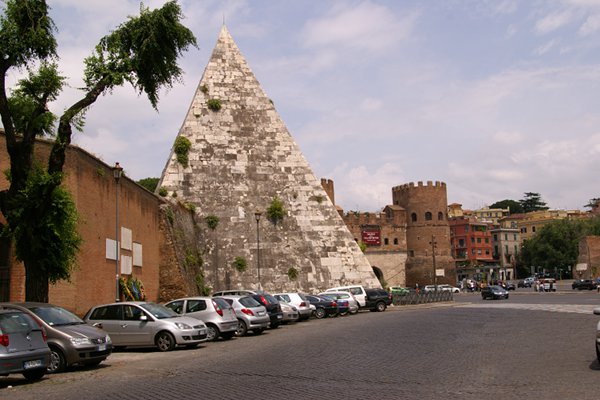
I got a room at the Hotel Pyramide, five minutes' walk from Ostiense
rail station, and the pyramid. To be honest, that was the first that
I'd heard that Rome had a pyramid, and not a modern folly either: an
honest-to-god antiquity, finished in 13BC. It's impressively large too.
Not Khufu-sized or anything, but as tall as a four or five storey
building. The man who left instructions in his will for building it as
his memorial, Cestius, had been a Roman diplomat in Egypt.
With the ungodly morning flight getting me in early, I checked in to
the hotel at about one, and shortly after departed on my first
exploration. I had no plan, apart from to wander, and wander I did, for
a very long time. I got back to the hotel, footsore, after four and a
half hours, and then went out later to get dinner -- just a pizza on
this occasion. Roman pizzas are unusually thin and crispy, which is a
good thing.
Back in the hotel, I tried my netbook, and found that of the dozen or
so wireless networks it could detect, one was not password-protected.
The signal was weak, but I was able to use the Internet quite
effectively for the rest of my stay.
Wednesday 8th June
This time, I had more of a plan. At my local metro station, Pyramide, I
bought a three-day metro, bus, tram and train ticket, and used it to
travel to Flaminia station on the North side of the city centre. I'd
made a couple of previous day trips to Rome, but I'd never seen the
famous Spanish Steps, which as I wittily commented, are not dance
moves. But first, Piazza del Popolo, near the station, quite grand, but
not terribly tourist-infested. There was a group of buskers though,
playing easy-listening jazz versions of popular songs.
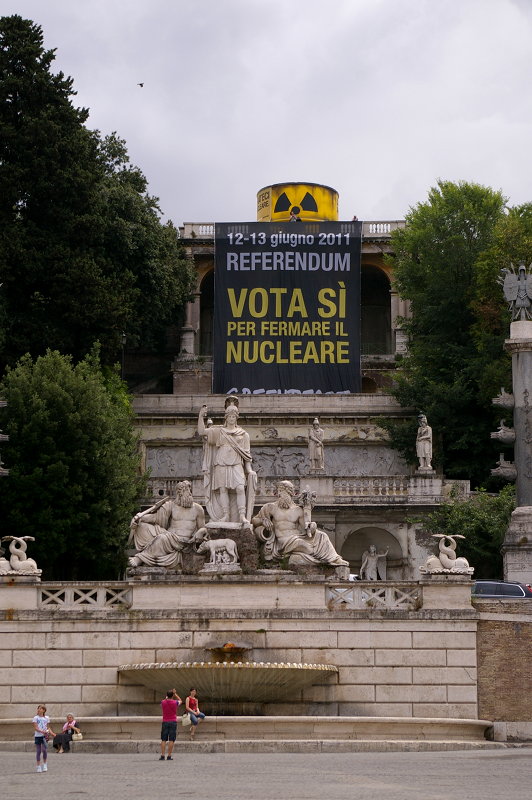 Up above the Piazza, at the balustrade of the
Pincio gardens, there was
a huge mock drum of radioactive waste, with slogans from Greenpeace
encouraging people to vote "si" in the upcoming referendum on ending
nuclear energy generation in Italy. I climbed up the hill, not so much
in search of nuclear waste, but to enjoy the view of the city.
Up above the Piazza, at the balustrade of the
Pincio gardens, there was
a huge mock drum of radioactive waste, with slogans from Greenpeace
encouraging people to vote "si" in the upcoming referendum on ending
nuclear energy generation in Italy. I climbed up the hill, not so much
in search of nuclear waste, but to enjoy the view of the city.
Then I made my way past the expensive shops of the Via del Babuino to
the Piazza Spagna and those well-known steps. All the tourists who had
ignored the Piazza del Popolo were massed in hordes in that area, but
it wasn't so bad. At the base of the steps sits Babington's Tea Rooms,
a refuge for Victorian lady tourists at one time, no doubt, but now
they let riffraff and Americans in. I had the bad luck to find a valid
one-day metro ticket on the ground. If only I'd found it before using
mine, I'd have saved a whole euro.
The next step on my plan was to visit the Ara Pacis Augustae, a very
large and ornate marble altar, built by the Roman state so that
sacrifices could be made to give thanks for the military victories of
Augustus. It has just finished a major restoration, and had a new
climate-controlled museum built around it. It's a very impressive piece
of work, and there are good maps and models to show how it would have
fitted into the contemporary landscape. There's also a small related
museum and an art gallery in the basement.
Across the street from the monument is the huge and unrestored tomb of
Augustus himself, just a big, overgrown drum-shaped building. It's only
open at weekends, apparently, so I didn't get in.
After a very late lunch, I found myself in the oval Piazza Navona,
another very touristy spot, but still very attractive and atmospheric.
I then moved Eastwards, with the intention of having a look at the
Forum, which, last time I'd been in Rome, you could visit for free.
However, now it's included in the Palatine, with an entrance fee, and I
was leaving that until Friday. I did scout out the location to buy the
ticket, and then got the metro back. I'd walked for even longer than
the day before.
In the morning, I'd noticed a "Wind" shop between the station and the
hotel. It's a telecom company; they don't sell wind. On the way
back, with much faulty Italian, I bought a SIM for fast, 3G Internet
via my plug-in "dongle", and then, with my free, unofficial wireless
connection to consult helpful websites, got it set up and working.
Ready for Umbria.
I went out for dinner later, looking for and failing to find a couple
of nearby restaurants recommended in my Rough Guide. I think their maps
are faulty. I'd passed a place near the hotel that looked passible, so
I returned to it. Not bad. Round the corner, I had seen the usual
styles and signs of the inevitable "Irish Pub"; by which I actually
mostly mean "Guinness" everywhere. Well, why not a Guinness as a
nightcap? But the pub, Mastro Tittus, isn't as Irish-themed in its
beers as in its decor, and they don't have any Guinness. Also, it's the
darkest pub I've ever been in, and the staff are quite rude. But that's
made up for by the range of specialist draft beers. I had a Belgian
wheat beer, and it was fruity and complex, suggesting hints of kiwi
fruit and banana. I went back the short distance to bed a happy man.
Thursday 9th June
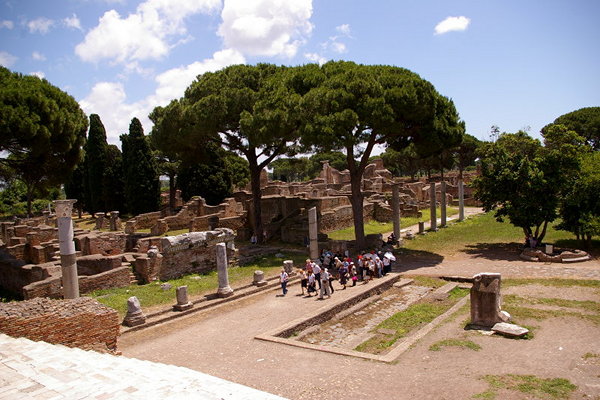 The additional advantage of my location near the local
rail network was
that I could take a train trip out of the city, and suburban
destinations were included in my three-day ticket. Part of the same
complex of platforms as Pyramide metro and Ostiense (for the airport)
is Porta San Paolo station, the terminus of a line to the Lido seaside,
but passing Ostia Antica, the original Roman port at the mouth of the
Tiber.
The additional advantage of my location near the local
rail network was
that I could take a train trip out of the city, and suburban
destinations were included in my three-day ticket. Part of the same
complex of platforms as Pyramide metro and Ostiense (for the airport)
is Porta San Paolo station, the terminus of a line to the Lido seaside,
but passing Ostia Antica, the original Roman port at the mouth of the
Tiber.
Ostia Antica silted up, and declined in importance until it was
eventually abandoned some time after 500AD. As a result, much of the
city was preserved, a large part just in foundations and ground plan,
but some parts still stand three storeys high or more. It's a huge
archaeological site (more walking). Some of the guidebooks say it gives
more of an idea of everyday Roman life than Pompeii, but I suspect
that's hyperbole. (I haven't yet been to Pompeii myself.)
One building I found particularly evocative was the fire station. It's
a building consisting of rooms around a large courtyard, or parade
ground actually, because the firemen were soldiers from Rome on a
rotating detachment. 400 of them lived and drilled on site, probably
sleeping in groups of ten in the little, cramped dormitory rooms around
the yard. The building is complete up to shoulder height, somehow
giving me an idea of what life would have been like there.
 Something
else that gave me a vivid impression of Roman life was the
theatre. I think we often have an image of the Roman public as a bunch
of bloodthirsty yobs, whose only entertainments were the bloody sports
of the amphitheatre. Yet here, in a Roman provincial city (albeit an
easy day's travel away from Rome) there was a theatre for seeing plays,
concerts, debates and other cultural performances. The setting is
superb, with the stage area backed by a very scenic columned temple on
a slight hill.
Something
else that gave me a vivid impression of Roman life was the
theatre. I think we often have an image of the Roman public as a bunch
of bloodthirsty yobs, whose only entertainments were the bloody sports
of the amphitheatre. Yet here, in a Roman provincial city (albeit an
easy day's travel away from Rome) there was a theatre for seeing plays,
concerts, debates and other cultural performances. The setting is
superb, with the stage area backed by a very scenic columned temple on
a slight hill.
One of the middle class houses made me think as well. The typical
design is rooms around a courtyard, whose long axis terminates in the
front door. All the rooms open onto the courtyard, so if one was your
bedroom, you'd come out of your bedroom door into the open air. I know
Middle-Eastern houses still can be like that, but it just seemed odd
somehow.
After having had enough of archaeology, I took the train back and
didn't get off at my stop, going on into the city centre instead, for a
little more exploration. I accidentally got lost and had to tramp
around quite a lot before I got my bearings again and made my way back
to the hotel.
That meant that I chose to eat locally again, and this time picked a
nice little place in the style of a French bistro (they were playing
Edith Piaf and the like on their stereo). The chef, and I guessed,
owner, actually looked like an Italian version of Gerard Depardieu, but
the single waiter was much like a young Elvis Costello, which was
slightly confusing.
Feeling brave, I ordered something which I didn't understand, fillet of
"branzino", suspecting it might be a fish, even though I rarely eat
fish. It was indeed. I looked it up when I got back and it's sea bass.
I quite enjoyed it, but the primo, pasta course was nicer.
I went into the dark, rude-staffed pub and tried another two of their
wheat beers.
Friday 10th June
My last day in Rome, meaning a mopping up of some of the tourist sites
previously omitted, principally the Palatine and Forum (which I'd seen
before) and the Colosseum (which I hadn't). One very useful tip I'd got
was to buy the combined ticket at the Palatine entrance to avoid the
long queue at the Colosseum. I had to wait in line for about ten
minutes. Later, when I got to the Colosseum, the queue actually looked
moderate, until I began to pass it by, ticket in hand, and realised
that it snaked round a good length of the interior, as well as
extending outside.
But first the Forum and the Palatine hill. As I mentioned, I'd been
there a couple of years previously, and that meant that I didn't really
need to explore diligently this time, trying to see everything. I could
just wander and take in the ambience.
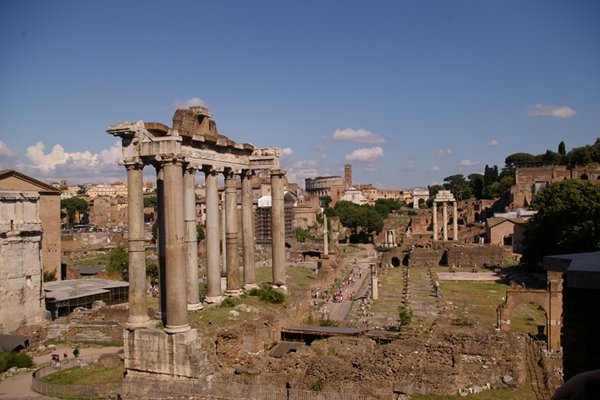 No need
for me to regurgitate the guidebook. Everyone knows about the
ruins of ancient Rome. The most striking thing for me was seeing the
building line for the foundations of some Renaissance palazzi at the
edge of what is now the archaeological area. Built on top of the Roman
ruins which are now visible, the ground level in the 1400s was
obviously about 10 metres higher than in Roman times, with four or five
stories of classical Rome totally buried.
No need
for me to regurgitate the guidebook. Everyone knows about the
ruins of ancient Rome. The most striking thing for me was seeing the
building line for the foundations of some Renaissance palazzi at the
edge of what is now the archaeological area. Built on top of the Roman
ruins which are now visible, the ground level in the 1400s was
obviously about 10 metres higher than in Roman times, with four or five
stories of classical Rome totally buried.
At the time of my visit, there was a special set of exhibits about the
Emperor Nero (I don't know -- perhaps an anniversary commemoration or
something). An attempt to rehabilitate the scoundrel, in a way, by
pointing out his achievements rather than his insane megalomania.
After I'd had enough of those ruins, I went over to the Colosseum, or
Flavian Amphitheatre, happily bypassing the queing throngs. One of the
purposes of the amphitheatre was propaganda: the Emperor Vespasian had
it built as part of a massive landscaping project aimed at eradicating
all of Nero's work. Inside the Colosseum, the Nero exhibition
continued, including large computer-generated vistas of what the site
would have looked like when it was part of his stupendous Villa Aurea
complex. Breathtaking.
The amphitheatre itself is worth seeing, even though it's like being on
a crowded building site. You can get some idea of the backstage and
underground workings, but there's really only the skeleton left.
I had one more site to visit: the Vatican. I wasn't going to have time
to do the museums justice, leaving them for another time, but I thought
I'd have a look inside the Basilica of St. Peter.
Well, I reached the sovereign state of the Vatican, without actually
realising the exact point when I left Italian territory. God did not
strike me down for the disbelieving heathen that I am, but Brother Sun
was radiating down some massive heat.
I sat in the shade of the porticoes for a while, took some photos, and
then investigated how I might get into the church. By long, long queue
across the bare piazza in the blazing sunshine was the answer.
Throughput would have been higher if people and their property hadn't
had to go through airport-style scanners. I decided to give it all a
miss.
I walked down the long avenue toward Castel S. Angelo, originally
Hadrian's tomb, but modified by Popes into a castle where they could
defend themselves from the occasional anti-clerical rage of the Roman
townsfolk. I crossed one of the bridges and wandered around the area of
Campo dei Fiori and Piazza Farnesi. When it got home time, I headed
East to the metro, quite a long walk, since the Roman metro isn't near
many of the historic sites: obviously built for commuters, not
tourists. I did consider getting on a bus at Piazza Venezia, but
couldn't find the right stop.
At the change of lines in Termini, I made a detour to the railway
station part (Termini is huge) and bought my ticket for the following
day - Rome to Chiusi-Chianciano is just under two hours by train and I
had the option of €9 standard class or €14 first class. That's surely
far, far cheaper than the equivalent on any of Britains "competing"
rail services. I then checked the platform for the departure -- yes, I
was a Boy Scout -- and found it was 1e. I spotted the signs pointing to
1e and 2e and returned to the metro for the short trip back to Pyramide.
That evening, after two quite expensive dinners, I choose pizza in a
local place. Actually, the waiter was quite surprised that all I wanted
was pizza even though he was working in an establishment clearly
labelled "pizzeria". Since I needed to be up at seven the next morning,
I gave the wheat beers a miss.